Informator uniwersytecki

numer 034
luty 2025
★
4
Welcome to Las Vegas part 2: The card games
The result of national and local evaluating system for academics has degenerated into a travesty similar to Las Vegas. I have previously pointed out some of the issues in the evaluation system (see Welcome to Las Vegas, part 1). Now, let’s move to some other issues.
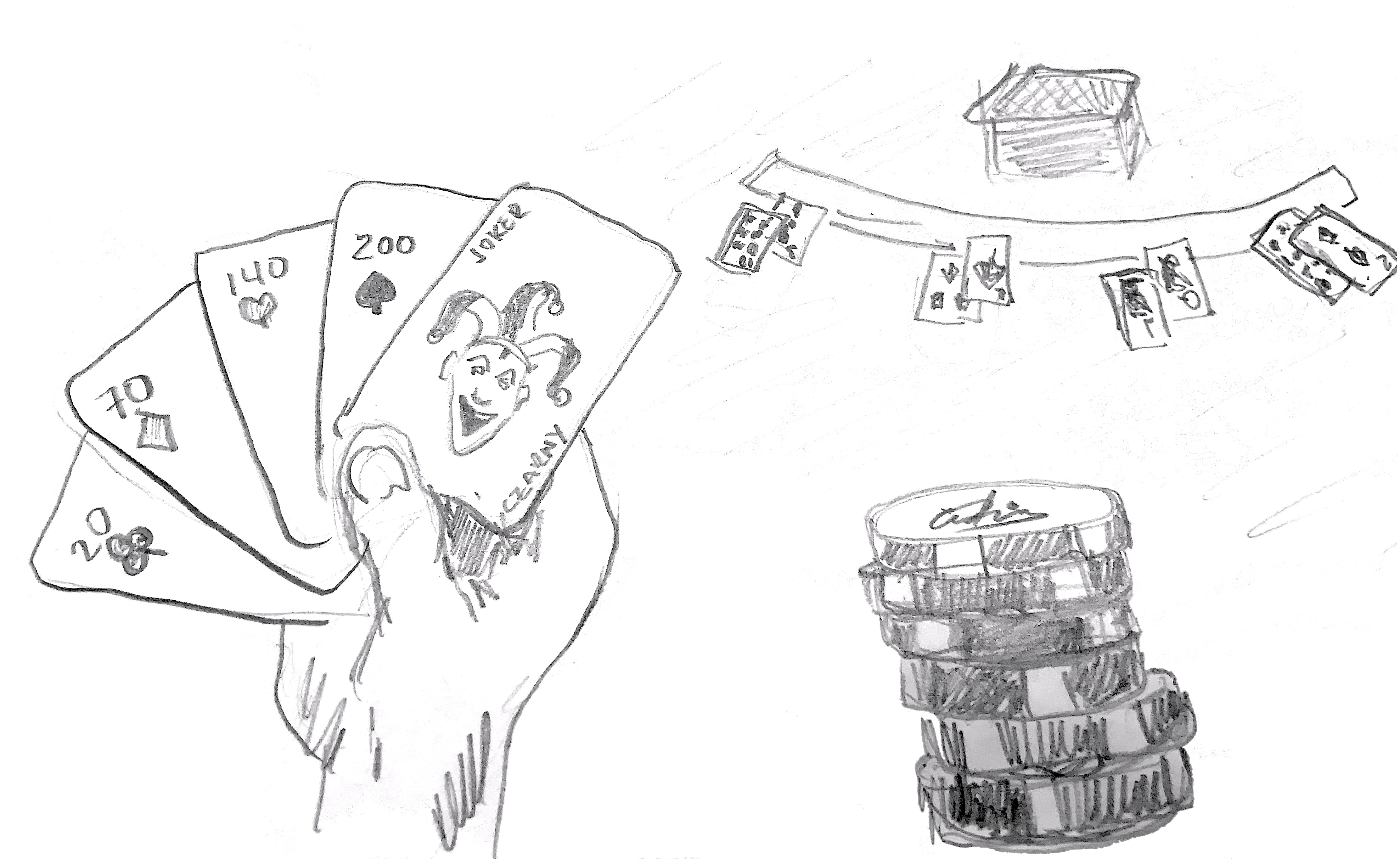
The game is to evaluate researchers and teachers. Easy! give them a hand of cards!
Battle Royal and its mutant ‘Tod und Leben’ (Life and Death):
The rule is simple: Scientific journals have different points depending of their impact factor and positioning within a discipline. Thus, “top” journals have 200 points, the next set 140, the next 100 points… etc. This concept allegedly promotes better research by rewarding researchers publishing in high-tier journals. But, is this true?
Before we make some calculations, let me note a few more important issues. The points provided by one article (200, 140, 100, 70, 40, 20) are then divided by the authors within the same discipline - if they are from Poland.
This means that if one of our teams generates 2 articles per year with 6 authors* (same discipline) in top-tier journals (200 points), each author gets 66,7 points per year.
Yet, if one researcher, as a single person from Poland (or a discipline) in a consortium of 369 international authors, publishes in a 200-point journal (s)he gets all 200 points.
Now, publishing a half-page clinical case report gets you 20-40 points, 2-3 of those per year equals the same as 2 top tier articles with several authors from your lab. Or in fact, writing one short article in “bottom” journals (70 points) with some friends from other disciplines and you have more points that 2 top papers with the members of a team.
Does this make any sense to anybody? Does this improve local science?
This system of diluting points does not support local collaborations, in effect it completely destroys them.
Some still believe that such actions promote more interdisciplinary research, as points are not diluted by collaborating with local people on other disciplines, but considering that one chooses the discipline one wants, this is completely artificial.
In addition to all this, the continuous evaluation means that one must be publishing approx. one article per year. Which is rather unfair for young scientists whom just began their careers, as publishing, in particular in “top” journals, requires years (YES! Years!!!) – and, was not the very idea to promote publishing in those?
Whether we like or not, research takes time and resources, and the pressing on faster and faster cannot result in other than less quality science. This also completely destroys any concept of undertaking a risky project**, as it might not produce enough or fast enough data and publications.
The stake of no complying with the card game is not just bargain chips but your job.
Many use the “Joker” of writing reviews, which is fine to do from time to time but please note that these have little value when applying for grants and wants to describe personal achievements.
No matter how good you do in this cards game, the house will always leave you in the lurch***
Note: this system fits me well, as I have lived abroad most of my adult life and have multiple international collaborations. Yet, I’m totally against it as it does not help me in the long-term to make a team that focuses in top science, undertake risky** projects, have fun discovering new things, and, most importantly, develop better interactions and specialities among the team members.
Battle Royal and its mutant ‘Tod und Leben’ (Life and Death):
The rule is simple: Scientific journals have different points depending of their impact factor and positioning within a discipline. Thus, “top” journals have 200 points, the next set 140, the next 100 points… etc. This concept allegedly promotes better research by rewarding researchers publishing in high-tier journals. But, is this true?
Before we make some calculations, let me note a few more important issues. The points provided by one article (200, 140, 100, 70, 40, 20) are then divided by the authors within the same discipline - if they are from Poland.
This means that if one of our teams generates 2 articles per year with 6 authors* (same discipline) in top-tier journals (200 points), each author gets 66,7 points per year.
Yet, if one researcher, as a single person from Poland (or a discipline) in a consortium of 369 international authors, publishes in a 200-point journal (s)he gets all 200 points.
Now, publishing a half-page clinical case report gets you 20-40 points, 2-3 of those per year equals the same as 2 top tier articles with several authors from your lab. Or in fact, writing one short article in “bottom” journals (70 points) with some friends from other disciplines and you have more points that 2 top papers with the members of a team.
Does this make any sense to anybody? Does this improve local science?
This system of diluting points does not support local collaborations, in effect it completely destroys them.
- Why to collaborate locally when points are diluted while one can collaborate with people abroad (who do just the same thing as the guy next door) without losing any points?
- Why to collaborate with the other people in your own lab if points are diluted?
Some still believe that such actions promote more interdisciplinary research, as points are not diluted by collaborating with local people on other disciplines, but considering that one chooses the discipline one wants, this is completely artificial.
In addition to all this, the continuous evaluation means that one must be publishing approx. one article per year. Which is rather unfair for young scientists whom just began their careers, as publishing, in particular in “top” journals, requires years (YES! Years!!!) – and, was not the very idea to promote publishing in those?
Whether we like or not, research takes time and resources, and the pressing on faster and faster cannot result in other than less quality science. This also completely destroys any concept of undertaking a risky project**, as it might not produce enough or fast enough data and publications.
The stake of no complying with the card game is not just bargain chips but your job.
Many use the “Joker” of writing reviews, which is fine to do from time to time but please note that these have little value when applying for grants and wants to describe personal achievements.
No matter how good you do in this cards game, the house will always leave you in the lurch***
Note: this system fits me well, as I have lived abroad most of my adult life and have multiple international collaborations. Yet, I’m totally against it as it does not help me in the long-term to make a team that focuses in top science, undertake risky** projects, have fun discovering new things, and, most importantly, develop better interactions and specialities among the team members.
Adolek
Time for showdown the cards – maybe this commentary gives me some points.
It is at least longer than a ‘case report’ and I did the calculations myself
*Well below the average number of authors in top journals such as Nature or Science where the average is more than 20 authors per article.
** ‘Risky’ projects are also called ‘high-risk, high-gain’ projects, which explain their importance.
*** Lurch refers to a decisive defeat in which an opponent wins a game by more than double the defeated player's score (Merriam-Webster dictionary).
Check out the previous articles:
Time for showdown the cards – maybe this commentary gives me some points.
It is at least longer than a ‘case report’ and I did the calculations myself
*Well below the average number of authors in top journals such as Nature or Science where the average is more than 20 authors per article.
** ‘Risky’ projects are also called ‘high-risk, high-gain’ projects, which explain their importance.
*** Lurch refers to a decisive defeat in which an opponent wins a game by more than double the defeated player's score (Merriam-Webster dictionary).
Check out the previous articles:
Welcome to Las Vegas (part 1)
Ready for a PhD? Part III
Ready for a PhD? Part II
Ready for a PhD? Part I







Redakcja zajmuje się opracowaniem dostarczonych materiałów do artykułów i nie odpowiada za ich wartość merytoryczną. Za wartość merytoryczną odpowiadają ich twórcy.
© 2022 Centrum Symulacji Medycznej UM w Lublinie